Nicaragua Economic Outlook 2026: Record Reserves, Shrinking Factories and a Tariff Deadline
Data verified as of 25 November 2026. By Juan Salva, Orbis Management.
The Nicaragua economic outlook for 2026 is a story of two economies. One is visible in the central bank’s headline numbers: growth of 4.9% in 2025, record international reserves and a currency that has not moved against the dollar. The other shows up on factory floors and at the U.S. border: tens of thousands of lost free trade zone jobs, falling apparel exports, and a new U.S. tariff that steps up on January 1, 2027. This post is for exporters selling into the United States and for U.S. firms sourcing from Nicaragua. It sets out what the data shows and what to do before the tariff change.
Key takeaways
- From January 1, 2027, Nicaraguan goods that do not originate under CAFTA-DR face a new 10% U.S. duty, rising to 15% in 2028. Proving CAFTA-DR origin is now the single most valuable compliance task.
- Since July 24, 2026, Nicaragua has also paid the 12.5% Section 301 forced-labor duty, against 10% for Guatemala, Honduras and El Salvador. CAFTA-DR duty-free textiles and apparel are exempt.
- The macro picture is stable: reserves near $9.8 billion, a fixed exchange rate and record coffee and gold earnings. But inflation has risen above 4%, and remittances of about 30% of GDP carry the consumer economy.
- Free trade zone employment fell by about 27,000 jobs between December 2024 and March 2026. Generous new tax breaks have not yet reversed the decline.
- Trade with China under the 2024 free trade agreement runs heavily one way, and Nicaragua has no independent courts, and its main business chambers have lost their legal status. Price both into any long-term commitment.
The headline numbers: stability on paper
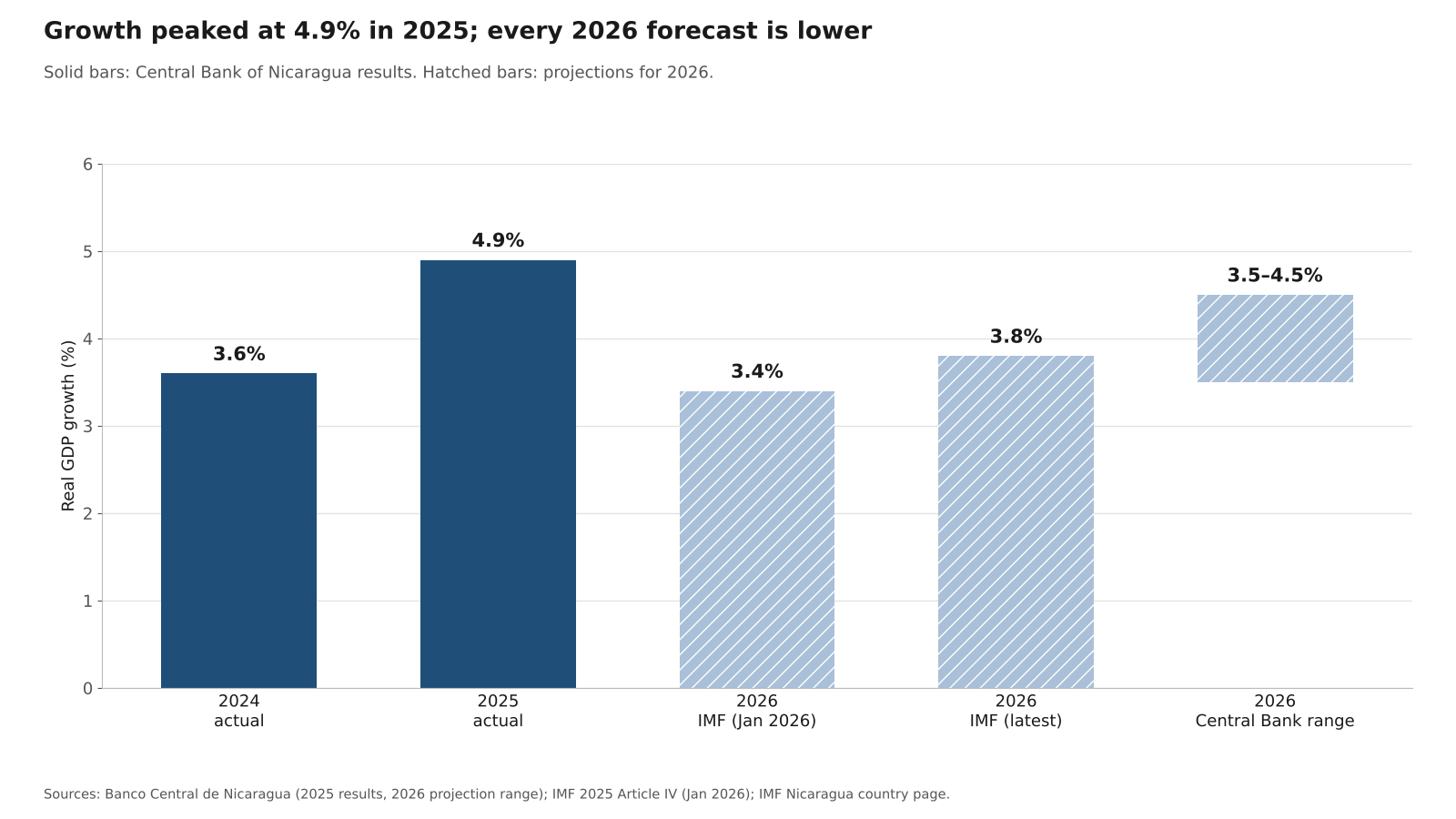
The Banco Central de Nicaragua (BCN) reported growth of 4.9% in 2025, the fifth straight year of expansion, and expects 3.5% to 4.5% in 2026. The IMF’s January 2026 Article IV was more cautious, projecting 3.4% for 2026 because it assumed lower remittances as U.S. immigration policy tightened. The IMF’s Nicaragua country page now shows 3.8%.
| Indicator | Latest figure | Source |
|---|---|---|
| Real GDP growth | 4.9% in 2025; 3.5%–4.5% projected for 2026 | BCN |
| Inflation | 4.33% year on year in October 2026, up from 2.7% for 2025 | INIDE, BCN |
| Gross international reserves | $8.32 billion at end-2025; $9.81 billion at end-June 2026 | BCN |
| Exchange rate | Fixed at C$36.6243 per dollar for 2026 (0% crawl) | BCN |
| Total exports | Record $8.91 billion in 2025 | BCN |
| Family remittances | About $6.2–6.3 billion in 2025, roughly 30% of GDP | IMF, IDB estimates |
Two of these numbers deserve a closer look. Inflation is no longer low: the BCN raised its 2026 inflation forecast in October to 3.5%–4.5%, citing El Niño and oil prices, and the statistics office reported 4.33% in October. Reserves, meanwhile, have grown fast. The BCN reported $8.32 billion at the end of 2025, roughly double the 2021 level, and $9.81 billion by June 2026. With the córdoba’s crawl held at 0% for 2026, currency risk on dollar contracts is low for now.
Remittances: the consumer economy runs on money from abroad
The BCN stopped publishing monthly remittance data in April 2025, so outside estimates fill the gap. The IMF put 2025 inflows at $6.315 billion, and the Inter-American Development Bank at $6.2 billion, about 30% of GDP. That compares with $5.24 billion, or 26.6% of GDP, in 2024. Retail demand, housing and bank deposits all lean on these flows, so any business selling to Nicaraguan consumers is exposed to U.S. immigration and labor policy. The missing official data is itself a risk: plan on independent estimates for remittances and some other statistics.
Coffee and gold carry the export boom
The 2025 export record rests mostly on commodity prices. Coffee earned $918.2 million in 2025 on 3.3 million quintals, with an average price of about $272 per quintal against roughly $194 in 2024. Gold exports topped $1.9 billion, according to the BCN. Price-driven gains can reverse. Coffee exports reached $691 million from January to September 2026, and the 2026-2027 harvest is projected at about 3 million quintals, below the last cycle.
The United States is still the anchor buyer. It took about 46% of Nicaragua’s export revenue in 2025, against 1.1% for China. For coffee exporters there is one piece of good news: coffee is on the exemption list for the 12.5% Section 301 duty, according to the USTR notice. Confirm your tariff line with a customs broker before quoting.
The free trade zone crisis
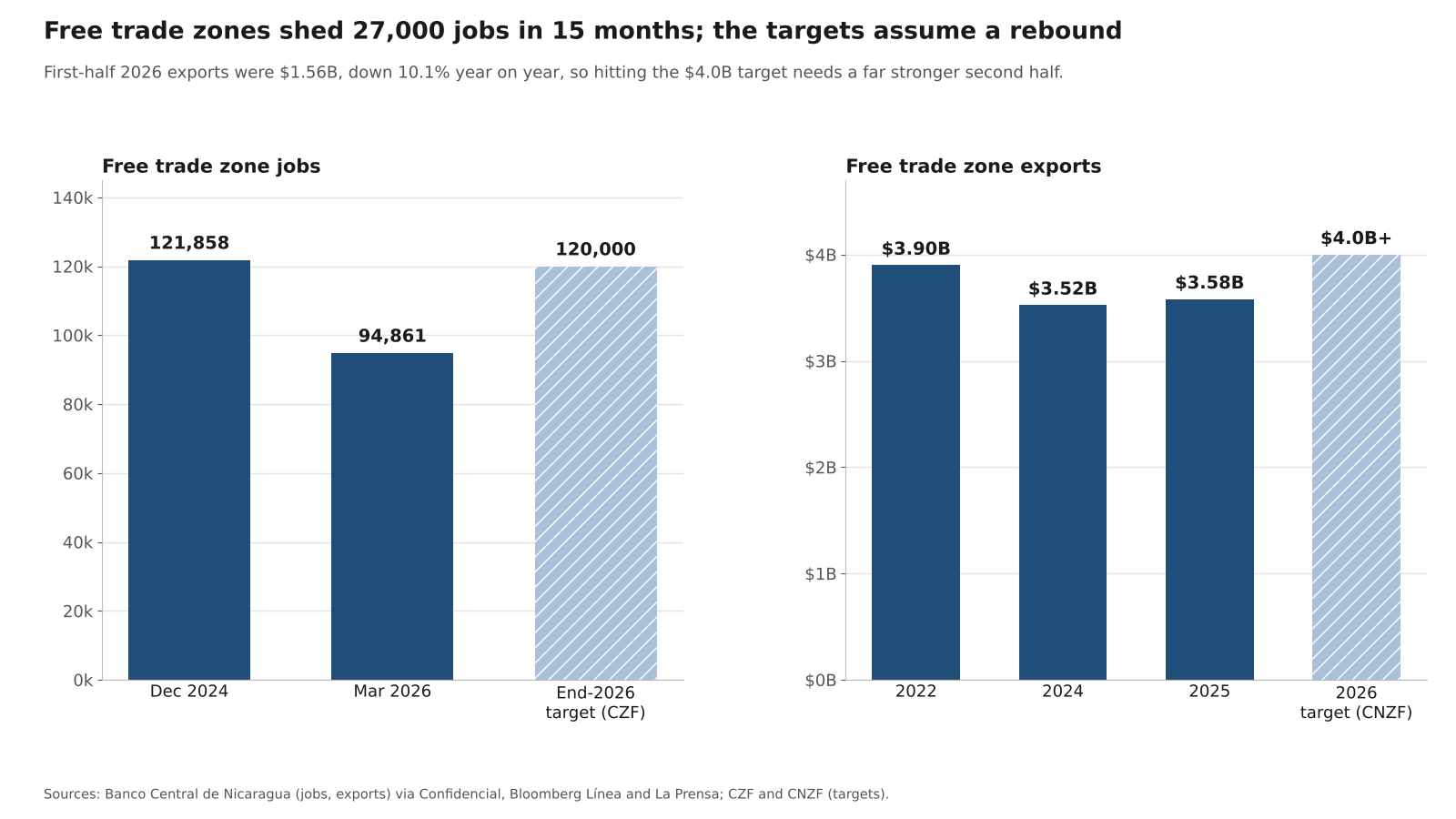
Nicaragua’s free trade zones, dominated by apparel, are where the strain shows most. Central bank figures reported by Confidencial show employment falling from 121,858 workers in December 2024 to 94,861 in March 2026, with 168 active companies against 191 in 2021. Exports fell to $3.52 billion in 2024 from about $3.9 billion in 2022, then edged up to $3.58 billion in 2025. In the first half of 2026 they dropped again, to $1.56 billion, down 10.1%, led by textiles. The BCN president attributed the fall to U.S. tariff policy.
The government’s response is a sharp increase in tax incentives. Law 1278, approved on April 8, 2026, amends the Export Free Trade Zone Law (Law 917). It grants operators a 100% income tax exemption for 15 years and users 10 years. Under the old rule a company got 15 years plus one extension. The new text allows successive renewals, each approved case by case by the national free trade zone commission, and extends the exemption to dividends. Wages are predictable too: a five-year agreement signed in 2022 sets free trade zone minimum wage increases at 6.7% in both 2026 and 2027, putting the monthly minimum at C$9,986.54 from January 2026.
Officials project a recovery to 120,000 jobs and more than $4.0 billion in exports in 2026. The first-half figures make both targets hard to reach. The case-by-case renewal also means the most valuable benefit depends on administrative approval rather than a fixed legal right.
U.S. tariffs: the date exporters need to plan around
U.S. duties on Nicaraguan goods have changed several times since 2025. The 18% “reciprocal” tariff of 2025 ended in February 2026, and a temporary 10% surcharge ran until July 2026. Two Section 301 actions now apply:
| Measure | Rate on Nicaraguan goods | Main exemptions |
|---|---|---|
| Section 301 forced-labor duty (since July 24, 2026) | 12.5%, against 10% for Guatemala, Honduras and El Salvador | CAFTA-DR duty-free textiles and apparel; listed products |
| Section 301 Nicaragua action (HTS 9903.89.01) | 0% in 2026; 10% from January 1, 2027; 15% from January 1, 2028 | Goods originating under CAFTA-DR |
The second measure follows USTR’s December 2025 finding on labor rights, human rights and the rule of law. It applies to all Nicaraguan goods that do not originate under CAFTA-DR, and USTR said it stacks with other duties. USTR also said the timeline and rates may change depending on Nicaragua’s progress. The forced-labor duty comes from a separate July 2026 notice covering 60 economies. Our Section 301 tariff table by country (in Spanish) lists the rate for every Latin American country.
The practical point: from January 1, a shipment that qualifies under CAFTA-DR rules of origin avoids the new Nicaragua duty, and one that does not pays it. Before the end of the year, exporters and U.S. importers should:
- Check that every product line meets its CAFTA-DR rule of origin, including the yarn-forward rule for apparel, and that certifications and supplier records are complete.
- Identify non-originating products and re-price landed costs with the new duty included. Ask a licensed customs broker to confirm how the two Section 301 duties combine for each tariff line.
- Consider whether goods entering the U.S. Southeast should go through a Foreign-Trade Zone or a bonded warehouse to defer duty. Our guide to Foreign-Trade Zones vs. bonded warehouses compares the options.
The China pivot: more imports than exports
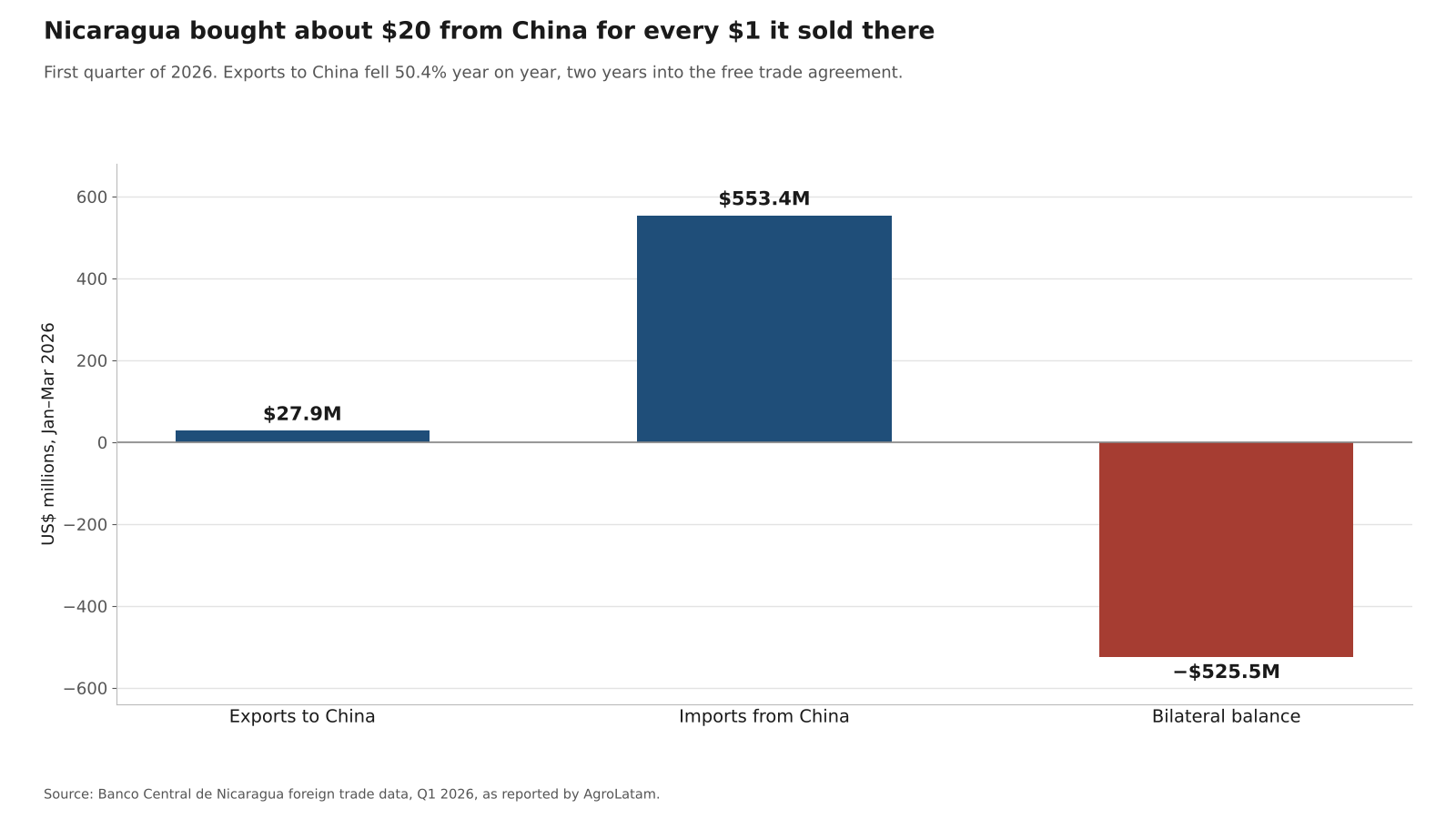
Nicaragua’s free trade agreement with China has been in force since January 1, 2024. So far it has mainly opened Nicaragua’s market to Chinese goods. In the first quarter of 2026, exports to China fell 50.4% to $27.9 million, while imports from China reached $553.4 million, a deficit of about $525.5 million in three months. China supplied 19.8% of Nicaragua’s imports in the first half of 2026, second only to the United States. In May the government removed tariffs on more Chinese machinery and agrochemicals.
China is also becoming the main lender. Budget execution data for the first quarter of 2026 showed China overtaking the Central American Bank for Economic Integration as the top external financier. The flagship project is a deepwater port at Bluefields on the Caribbean coast, under an engineering and construction contract with China CAMC Engineering. A CABEI study estimated the cost at about $594 million. The transport ministry said phase one construction would start in April 2026 but has not disclosed the current cost or financing. Suppliers bidding on state-linked projects should expect to deal with Chinese contractors and should run sanctions screening on every counterparty using OFAC’s sanctions search.
Operating risks that belong in every business case
No courts or business chambers to appeal to
The January 2025 constitutional reform created a co-presidency and placed the legislative, judicial and electoral bodies under the “coordination” of the presidency. In practice, companies should not count on independent courts to settle disputes with the state. The business community has also lost its formal voice. In March 2023 the government cancelled the legal status of COSEP and 17 member chambers, including the textile association. More than 5,600 non-profit organizations have been closed in total, with their assets passing to the state.
Thin and delayed data
Remittance figures have not been published since April 2025, and local media report delays in other official statistics. Build plans on several sources and keep margins wide.
Labor-market fragility
Falling factory employment and the economy’s reliance on emigrants’ remittances point to a weak domestic job market. That is a risk for consumer demand. For manufacturers it also means recruiting and keeping skilled staff takes work.
Nicaragua’s stability is real, but it rests on remittances, commodity prices and a fixed exchange rate rather than on institutions a company can rely on.
What to watch through 2027
- January 1, 2027. The 10% Nicaragua duty takes effect on non-CAFTA-DR goods. Watch for any change USTR makes to the schedule.
- Free trade zone exports in the second half of 2026. These will show whether the new tax incentives are working against the tariff headwind.
- Inflation. October’s 4.33% is near the top of the BCN’s revised range. Food and fuel prices are the swing factors.
- Remittance flows. Any tightening in U.S. immigration enforcement feeds directly into Nicaraguan consumer demand.
- Bluefields port. Whether construction moves forward, and on what financing terms, will show how far Chinese credit replaces multilateral lenders.
For exporters, the Nicaragua economic outlook for 2026 comes down to one practical point: stable macro numbers do not offset tariff and legal risk. Firms that secure CAFTA-DR origin, price in the 2027 duty and limit their exposure to the state can still trade profitably with Nicaragua.
Frequently asked questions
What U.S. tariff applies to Nicaraguan goods in 2027?
From January 1, 2027, goods of Nicaragua that do not originate under CAFTA-DR pay an additional 10% Section 301 duty, rising to 15% on January 1, 2028. Separately, the 12.5% Section 301 forced-labor duty in force since July 24, 2026 applies to most Nicaraguan goods, with exemptions that include CAFTA-DR duty-free textiles and apparel. Confirm the treatment of each tariff line with a licensed customs broker.
Are Nicaraguan apparel exports still competitive?
Apparel that enters duty-free under CAFTA-DR avoids both Section 301 duties, so qualifying garments keep their access. Free trade zone exports and jobs have fallen since 2024, and active companies fell from 191 in 2021 to 168 by March 2026, so buyers should check each supplier’s stability and origin documentation.
What incentives does Nicaragua offer free trade zone investors?
Law 1278 of April 2026 grants a 100% income tax exemption for 15 years to operators and 10 years to users, renewable case by case, and extends the exemption to dividends. Free trade zone minimum wages rise 6.7% in 2026 and again in 2027 under a 2022 agreement.
Is Nicaragua’s exchange rate stable?
Yes, for now. The central bank fixed the rate at C$36.6243 per U.S. dollar for 2026 with a 0% crawl, backed by reserves of about $9.8 billion in mid-2026.
Trading with Nicaragua before the 2027 tariff change?
Origin rules, stacked Section 301 duties and counterparty risk all affect whether a Nicaraguan supply line still works. Tell us what you are evaluating and we will help you scope the questions that matter.
Weighing other Central American options? Read our Guatemala nearshoring outlook for 2026.
This article is for informational purposes only and does not constitute legal, financial, customs, or trade advice. Tariff treatment depends on the specific product and its origin; consult a licensed customs broker or qualified advisor before making decisions.
Third-party and government source content is referenced under fair use or public-domain terms, as applicable.
© 2026 Orbis Management. All rights reserved.